Hey guys,
As you know, I like to update you with when the ISS is going to fly by. It is scheduled to make some exciting flybys over the next few days (remember, you can use the SpaceWeather link to track the ISS and other satellites... http://www.spaceweather.com ). Anyway, on August 4th and 5th, you can see the ISS fly over three times!!! That is amazing! Use the link above to SpaceWeather.com to see when if will fly by your area. Remember, the lower the number for magnitude, the brighter the object will appear to be.
Don't forget to check back to SpaceWeather.com daily for updated information about what is going on in space! Hope you all are having a great summer and I will see you in a few weeks for the start of school!!!
For now...keep an eye to the sky!
Ms. T
Wednesday, July 31, 2013

Wednesday, October 31, 2012


Friday, October 5, 2012
We do science...
We made density layers of liquids in cups, observed the flow of materials through plants, made marshmallow energy launchers, designed earthquake safe buildings, observed the stress in Earth's crust, and planted some grass seeds in cool cups! The kids drew faces on the cups so that when the grass grows it becomes their hair...stay tuned for more pictures the "hair" grows and as we do more projects! 


Tuesday, October 2, 2012
New posts this year
Hi guys! This year I would like to get you all more involved with posting blogs. Anyone with any ideas please see me during class.
Tuesday, June 5, 2012
Transit of Venus!
We're looking but it's cloudy!! We got lucky and saw the transit for a little bit! 
Friday, June 1, 2012
Transits and Transitions
Hi All,
There are a LOT of things going on that we need to get caught up with! We have the transit of Venus, the ISS, a shape-stealing octopus and more!
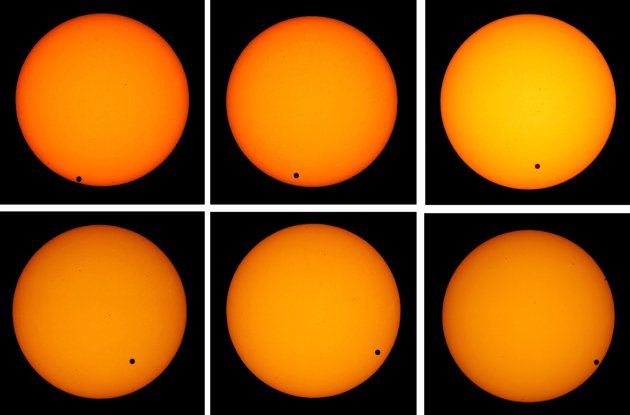
First, let's start with the transit of Venus. This is quite a big deal! When there is one transit of Venus, they come in pairs (the last in 2004 with it's partner being this year!). This is a very interesting phenomenon that will not happen again until the year 2117. However, the 2117 transit will not be visible from the east coast of the US. The next transit that will be visible by us is 2125! What is the transit of Venus? The transit of Venus is similar to a solar eclipse. The Sun, Venus, and Earth will align in such a way that Venus will cause a sort of eclipse of the Sun. Now, this is not, in any way, a solar eclipse, where the entire disc of the sun is covered, but it is really cool to see! This transit will take place on Tuesday (June 5, 2012). It will begin at about 5:05pm. Unfortunately, we will not be able to see the entire transit, as the Sun will have set by then, but it should still be pretty awesome! I will be setting up somewhere to view the transit, and you all (along with your families) are welcome to join! I am not sure of an exact place yet, because I need to find somewhere with a clear view of the western sky (sunset). One of the most important things is that you need to do is protect your eyes. You need special solar viewing glasses (NOT just sunglasses). I have a bunch that we can use. Below is a diagram explaining the transit and a series of photos from the 2004 transit. The diagram was taken from Wikipedia (http://en.wikipedia.org/wiki/File:Venus_Transit_%26_Parallax.svg) and the series of images was taken from Yahoo! News (http://news.yahoo.com/photos/transit-of-venus-slideshow/;_ylt=AoicNEqVsnqMu2OctY28TQ8PLBIF;_ylu=X3oDMTRwc2U5djNoBG1pdANWaWRlbyBGZWF0dXJlZCBDYXJvdXNlbCBTY2llbmNlBHBrZwNiZWM2NWY3ZS1hZGNhLTM2N2EtOTY4MS01NzlmNTI3N2U1Y2YEcG9zAzMEc2VjA01lZGlhRmVhdHVyZWRDYXJvdXNlbFRlbXAEdmVyA2M0ODkyMDQzLWFiZWYtMTFlMS1iN2JmLThiYTVkNDU4ZWM2Mw--;_ylg=X3oDMTFlamZvM2ZlBGludGwDdXMEbGFuZwNlbi11cwRwc3RhaWQDBHBzdGNhdAMEcHQDc2VjdGlvbnM-;_ylv=3)


One more cool thing about the transit of Venus. There is an astronaut on the ISS who will be the first human to witness AND photograph the transit from SPACE! That's going to be awesome! I can't wait to see it!
ISS
While we are on the topic of astronomy, there are a few ISS flybys we should be on the look out for. Ironically enough, one of them is on June 5! We are really lucky because on both June 5 and 6, the ISS will be passing over twice each day!!! What a great day/night for sky watchers! Here is the info for the ISS flybys (info from spaceweather.com
Tuesday 6/5: 5:28:53am - 5:32:08am WNW 77 degree max elevation -3.9 magnitude
6/5: 10:06:35pm-10:09:38pm SSW 42 degree max elevation -3.0 magnitude
Wednesday 6/6: 4:34:55am-4:37:59am NNW 39 degree max elevation -2.8 magnitude
6/6: 10:48:50pm- 10:51:52pm W 38 degree max elevation -2.8 magnitude
*remember...the lower the number for magnitude, the brighter the object is!
Space Shuttle Discovery
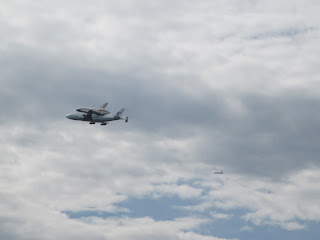
I know this was a while ago, but I was never able to get the pictures on my blog for you all to see (even though I showed them to you guys in class!). I will never forget that day! I was so excited that it flew over our school...right by my window! I am glad that some of you go to see it! What a great moment, as a teacher, to be able to watch it fly over with you guys! Anyway, here are some photos of Discovery as it flew over our area. I do not have any pictures of it flying over our school, but I have some pictures that my dad and some of your parents sent me from around our area. Also, Mrs. Cap took a video that she shared with me that I will post (Thanks Mrs. Cap!!!). Farewell, Discovery, and thank you for your service!




And here is the video from Mrs. Cap!
Partial Lunar Eclipse.
This space stuff just keeps getting better and better!! On Monday, there will be a partial lunar eclipse. You don't need any special eye protection to view the lunar eclipse, since you are not looking directly at the sun. Remember, the lunar eclipse occurs when the Earth is between the Sun and the Moon. Below are some diagrams and pictures taken from www.space.com Unfortunately, for us, we will not really get to see much of the eclipse. If you get a chance, you should go out anyway to see what little bit will be visible at your location! The eclipse should start around 4:48am.


Swiss...plane?
The Swiss have developed a solar powered plane! It is working on its first transcontinental flight! Check out the solar panels on the plane! (pictures taken from yahoo www.yahoo.com)

What is That??
I came across a cool story about an adaptation of an octopus!
Check it out! The octopus is making itself look like a shell to avoid predators! AWESOME!!
Here is the link to the site...for some reason, I can't get the picture on here.
http://news.yahoo.com/octopus-foils-predators-stealing-identities-210832940.html;_ylt=A2KJ3CcolclPVGoA.ynQtDMD
FINALLY!
I have found a cool video on light via minutphysics on YouTube. You should check out and/or subscribe to their channel. They post some great physics clips!
OK, well I have really enjoyed working with you all this year! Stay tuned over the summer for some more updates. Next year, I am going to rely on you guys for blog updates!
Also, tonight, I have just returned from the 8th grade graduation. What a great group of kids making the transition from middle school to high school! You all will do great in high school! Good luck, best wishes, and Godspeed!
Just because you graduated, doesn't mean you cant check out the blog every once in a while to stay updated with whatever science is in the news.
Keep an eye to the sky (especially a protected eye on Tuesday!),
Ms. T
There are a LOT of things going on that we need to get caught up with! We have the transit of Venus, the ISS, a shape-stealing octopus and more!
First, let's start with the transit of Venus. This is quite a big deal! When there is one transit of Venus, they come in pairs (the last in 2004 with it's partner being this year!). This is a very interesting phenomenon that will not happen again until the year 2117. However, the 2117 transit will not be visible from the east coast of the US. The next transit that will be visible by us is 2125! What is the transit of Venus? The transit of Venus is similar to a solar eclipse. The Sun, Venus, and Earth will align in such a way that Venus will cause a sort of eclipse of the Sun. Now, this is not, in any way, a solar eclipse, where the entire disc of the sun is covered, but it is really cool to see! This transit will take place on Tuesday (June 5, 2012). It will begin at about 5:05pm. Unfortunately, we will not be able to see the entire transit, as the Sun will have set by then, but it should still be pretty awesome! I will be setting up somewhere to view the transit, and you all (along with your families) are welcome to join! I am not sure of an exact place yet, because I need to find somewhere with a clear view of the western sky (sunset). One of the most important things is that you need to do is protect your eyes. You need special solar viewing glasses (NOT just sunglasses). I have a bunch that we can use. Below is a diagram explaining the transit and a series of photos from the 2004 transit. The diagram was taken from Wikipedia (http://en.wikipedia.org/wiki/File:Venus_Transit_%26_Parallax.svg) and the series of images was taken from Yahoo! News (http://news.yahoo.com/photos/transit-of-venus-slideshow/;_ylt=AoicNEqVsnqMu2OctY28TQ8PLBIF;_ylu=X3oDMTRwc2U5djNoBG1pdANWaWRlbyBGZWF0dXJlZCBDYXJvdXNlbCBTY2llbmNlBHBrZwNiZWM2NWY3ZS1hZGNhLTM2N2EtOTY4MS01NzlmNTI3N2U1Y2YEcG9zAzMEc2VjA01lZGlhRmVhdHVyZWRDYXJvdXNlbFRlbXAEdmVyA2M0ODkyMDQzLWFiZWYtMTFlMS1iN2JmLThiYTVkNDU4ZWM2Mw--;_ylg=X3oDMTFlamZvM2ZlBGludGwDdXMEbGFuZwNlbi11cwRwc3RhaWQDBHBzdGNhdAMEcHQDc2VjdGlvbnM-;_ylv=3)

One more cool thing about the transit of Venus. There is an astronaut on the ISS who will be the first human to witness AND photograph the transit from SPACE! That's going to be awesome! I can't wait to see it!
ISS
While we are on the topic of astronomy, there are a few ISS flybys we should be on the look out for. Ironically enough, one of them is on June 5! We are really lucky because on both June 5 and 6, the ISS will be passing over twice each day!!! What a great day/night for sky watchers! Here is the info for the ISS flybys (info from spaceweather.com
Tuesday 6/5: 5:28:53am - 5:32:08am WNW 77 degree max elevation -3.9 magnitude
6/5: 10:06:35pm-10:09:38pm SSW 42 degree max elevation -3.0 magnitude
Wednesday 6/6: 4:34:55am-4:37:59am NNW 39 degree max elevation -2.8 magnitude
6/6: 10:48:50pm- 10:51:52pm W 38 degree max elevation -2.8 magnitude
*remember...the lower the number for magnitude, the brighter the object is!
Space Shuttle Discovery
I know this was a while ago, but I was never able to get the pictures on my blog for you all to see (even though I showed them to you guys in class!). I will never forget that day! I was so excited that it flew over our school...right by my window! I am glad that some of you go to see it! What a great moment, as a teacher, to be able to watch it fly over with you guys! Anyway, here are some photos of Discovery as it flew over our area. I do not have any pictures of it flying over our school, but I have some pictures that my dad and some of your parents sent me from around our area. Also, Mrs. Cap took a video that she shared with me that I will post (Thanks Mrs. Cap!!!). Farewell, Discovery, and thank you for your service!


And here is the video from Mrs. Cap!
Partial Lunar Eclipse.
This space stuff just keeps getting better and better!! On Monday, there will be a partial lunar eclipse. You don't need any special eye protection to view the lunar eclipse, since you are not looking directly at the sun. Remember, the lunar eclipse occurs when the Earth is between the Sun and the Moon. Below are some diagrams and pictures taken from www.space.com Unfortunately, for us, we will not really get to see much of the eclipse. If you get a chance, you should go out anyway to see what little bit will be visible at your location! The eclipse should start around 4:48am.


Swiss...plane?
The Swiss have developed a solar powered plane! It is working on its first transcontinental flight! Check out the solar panels on the plane! (pictures taken from yahoo www.yahoo.com)

What is That??
I came across a cool story about an adaptation of an octopus!
Check it out! The octopus is making itself look like a shell to avoid predators! AWESOME!!
Here is the link to the site...for some reason, I can't get the picture on here.
http://news.yahoo.com/octopus-foils-predators-stealing-identities-210832940.html;_ylt=A2KJ3CcolclPVGoA.ynQtDMD
FINALLY!
I have found a cool video on light via minutphysics on YouTube. You should check out and/or subscribe to their channel. They post some great physics clips!
Also, tonight, I have just returned from the 8th grade graduation. What a great group of kids making the transition from middle school to high school! You all will do great in high school! Good luck, best wishes, and Godspeed!
Just because you graduated, doesn't mean you cant check out the blog every once in a while to stay updated with whatever science is in the news.
Keep an eye to the sky (especially a protected eye on Tuesday!),
Ms. T
Thursday, March 15, 2012
Black Holes
In 8th grade, we are learning about the electromagnetic spectrum. We watched a Discovery Video about black holes because they discuss various parts of the spectrum dealing with black holes. One of my students shows me this video that he saw on YouTube. It is pretty awesome...
Thursday, March 1, 2012
More rainbows
We ate talking about the electromagnetic spectrum in 8th grade...so we experimented with prisms and sunlight! 


Wednesday, February 15, 2012
It's Been a While
Let's look into the International Space Station (ISS) flybys. The ISS will be making a pass over our area tomorrow night. At 5:57:55pm-6:00:59pm if y
ou look WSW you should be able to see the ISS fly over. It should reach a max elevation of 56 degrees and will have a magnitude of -3.5. Remember...the lower the number (for magnitude) the brighter the object is. This is kind of opposite thank what you would probably think. If you need more information you can go to the spaceweather website (www.spaceweather.com).
Next, let's look at the sun. There have been a few solar storms in the past few weeks. These solar storms have cause little to no damage to us on Earth (one was strong enough to cause some flights to be rerouted) but produced some amazing auroras. Check out some of the pictures below (all from spaceweather.com).


Check out spaceweather.com for more aurora pictures.
Remember, the sun is on an 11 year cycle. There is a solar minimum and a solar maximum. right now, we are climbing towards solar maximum which means that there is much more activity on the sun.
Check out this cool video of the ISS crew flying over and filming the aurora. I found this video at www.space.com
I found this youtube video of a cool way to fold and tape paper...you can make an awesome toy with it! Try it and let me know!!!
Ok, well, let me know some things that you would like to see on here. Send it to me in an e-mail an you might just get a prize!
Keep an eye to the sky!
Ms. T


Saturday, December 31, 2011
Happy new year
Happy new year all!! See you in a few days!!! Hope 2012 brings you much health and happiness along with many joys and blessings! God be with you!
Tuesday, November 1, 2011


Saturday, October 22, 2011
October News...Sunspots galore and more
Hello all!


Anyway, that's all for now. Hope you guys enjoyed this post.
Thanks to StumbleUpon.com...I thought I would share some of these cool pictures that I came across...


I hope you have had a great start to the school year so far! I know that I have enjoyed working with you guys so far this year! I hope you were able to check out my posting of the rainbow and praying mantis that I saw at our school last week! Both were spotted at the same time!! That was pretty cool!
Let's start off with some space news...
First of all, tonight is the peak of the Orionid Meteor Shower. If you look outside (best viewing time is between 1-3am) up at the constellation Orion (*hint look
for the three stars that form "Orion's Belt"), with fairly clear conditions, you should be able to see about 15-20 meteors per hour. Tonight, the moon won't be full, which is in your favor (it will be about 25% illuminated). It is, however, supposed to be partly cloudy, so sky conditions may be hit or miss. If you are having trouble finding Orion, it should be overhead around 2am. Below is a picture of the constellation, so you can see what it looks like.
Sunspots
As of right now, there are several active regions on the sun, including several sunspots. Remember (8th grade...) that a sunspot is a dark area of cooler gas (as compared to the gasses surrounding it). Sunspots are often related to things such as solar flares and coronal mass ejections. If you remember, the sun is on an 11 year cycle, each cycle with a solar minimum(where solar activity is low) and a solar maximum (where solar activity is high). Right now, we are currently climbing towards solar maximum (expected between 2012 and 2013). As we move towards solar maximum, the activity on the sun will increase, which also increases the chances of solar storms. Who knows what some impacts of solar storms are? If you write it down on a note card and bring it to me in school, you can get an extra point on your lowest test score!
Below is a picture of what the sun looks like (as on October 22, 2011), notice the sunspots. The photo was taken from SpaceWeather (www.spaceweather.com)
Apollo 11 and Apollo 17 Landing Sites on the Moon
NASA has proposed guidelines to protect and preserve both the Apollo 11 and Apollo 17 landing sites on the lunar surface. If you remember, Apollo 11 was the mission that carried Neil Armstrong, Edwin "Buzz" Aldrin, and Michael Collins to the moon, allowing for Armstrong and Aldrin to be the first people to ever set foot on the surface of the moon. Apollo 17 was NASA's final Apollo mission. Obviously, these missions, along with all of the Apollo missions are a very important piece, not just for American History, but for World History as well. When Neil Armstrong took that first step off of the Lunar Landing Module's ladder, he did not just represent the United States, but the entire world. When he first stepped off of the ladder, he said, "That's one small step for man, one giant leap for mankind." What do you think that he meant by this? Anyway, you can see why NASA would want to protect such an important piece of history. If NASA did not prepare those guidelines, than the landing sites could be damaged by future missions to the moon. This article was found on Yahoo! News (www.news.yahoo.com). Below is a brief video from YouTube about the Apollo 11 mission.
Anyway, that's all for now. Hope you guys enjoyed this post.
See you in school!
Keep an eye to the sky,
Keep an eye to the sky,
Ms. T
Thanks to StumbleUpon.com...I thought I would share some of these cool pictures that I came across...


Wednesday, October 19, 2011


Saturday, September 3, 2011
Welcome to the New School Year!
Hello all!
International Space Station Flyby
On Monday, September 5, 2011, the International Space Station will be flying over our area. If you want to go see it, here is what you need to know!
Look to the SSW at 7:42:06pm on Monday night. You should see something that looks like a star that is moving across the sky. You might think that it is an airplane. but it does NOT have any green or red lights, or it does NOT have blinking lights. It will reach a max elevation of 35 degrees.
So, if you get a chance, go outside, look up, and wave at the astronauts!
I found this picture via stumbleupon.com. It is such a great picture! The Milky Way over the Himalayas. Photo was found via Stumbleupon.com from Anton Jankovoy. Great Picture!!
Welcome back to a GREAT school year! What have you all done over the summer? This summer, I worked at a summer camp, went to my cousin's wedding in New York, and went to the Outer Banks, North Carolina! Well, now that we all had a great summer, we have to start looking towards the new school year. For those of you who are new (both to the school, or to my classes), I use this blog to alert you to different things that are going on, dealing with the realm of science. Remember, I have the "Science in the News" board in my classroom where you can bring in different science news articles that you find in the newspaper or on the internet! Just remember to put the summary on an index card for us to hang up with it. Also, please remember that you are free to comment on these blogs (they are not posted, however, until I approve them), but I want you to remember that since this is a public blog, I do not want you to use your name. If you would like to sing your comment, please just use your initials.
OK, NOW to the science...
Well, as I am sure you all know by now...space is my FAVORITE branch of science! I love it all! So, I think it is probably best to start with that. Over the summer, in July (July 8, 2011) the Space Shuttle Program came to an end. The three shuttles (Discovery, Atlantis, and Endeavor) have been officially retired. The Shuttle Program has had many significant achievements over it's 30+ year history. Some important events have been the launch/deployment of the Hubble Space Telescope and of course the building of the International Space Station. There have also been some tragedies as well. In 1986, Challenger disintegrated 73 seconds into the flight. There was a problem with the solid rocket booster, and unfortunately all 7 crew members died. In 2003, Columbia burned up during re-entry. This was due to damage of the thermal protection system (heat shield) during lift off. Sadly, all of these crew members died.
Below is a video of the final lift off of Space Shuttle Atlantis, which brings the shuttle program to an end. The video was taken from youtube.com, which was taken from Nasa.gov.
International Space Station Flyby
On Monday, September 5, 2011, the International Space Station will be flying over our area. If you want to go see it, here is what you need to know!
Look to the SSW at 7:42:06pm on Monday night. You should see something that looks like a star that is moving across the sky. You might think that it is an airplane. but it does NOT have any green or red lights, or it does NOT have blinking lights. It will reach a max elevation of 35 degrees.
So, if you get a chance, go outside, look up, and wave at the astronauts!
I found this picture via stumbleupon.com. It is such a great picture! The Milky Way over the Himalayas. Photo was found via Stumbleupon.com from Anton Jankovoy. Great Picture!!
 Jankovoy (jankovoy)) on 500px.com" border="0" style="margin: 0 0 5px 0;"> Jankovoy (jankovoy)) on 500px.com" border="0" style="margin: 0 0 5px 0;">
Milky Way above the Himalayas by Anton Jankovoy |
Well, that's all for now. We will look at some other things through out the year.
Keep and eye to the sky,
Ms. T
Monday, May 16, 2011
STS-134
This morning is the final flight of Space Shuttle Endeavour. The launch is slated to be at 8:56am. We'll keep an eye on it. More to come later!
Saturday, October 9, 2010
Science Anyone???
Hello all!
First of all, I would like to say that I think I have a very FUN way to start off Astronomy Club this year! Begin looking for details in school this upcoming week!


 OK, well, that's all for now! Keep an eye out on the news for any interesting stories! Fell free to bring them in to school to share with the class!
First of all, I would like to say that I think I have a very FUN way to start off Astronomy Club this year! Begin looking for details in school this upcoming week!
Ok, let's take a look at what's going on in the world of science...
ISS FLYBYS
I looked up to see if the ISS is flying by this week, and it does not look like it is. However, it appears as though there is a number of other satellites that will be making a pass over the area these next few days. For more information on these flybys, go to Spaceweather.com's satellite tracking tool at www.spaceweather.com/flybys
SUNgazer!
I was searching the internet for some new, cool science/astronomy sites, and I came across Sungazer. This website provides some pretty cool pictures of the sun taken in different parts of the electromagnetic spectrum as well as provides resources and information about observing the sun! Check it out at http://www.sungazer.net/
Shuttle Launch
The next Shuttle launch is scheduled for Monday, November 1 at 4:40pm. The STS-133, Space Shuttle Discovery will make its way to the International Space Station. We will be keeping an eye on this, and looking more into it as the launch date (and Space ShuttleDiscovery's final flight) gets closer. Hopefully, you all can view the launch! Watching a launch (if only from the TV) is awesome! One day, I hope to go down to Cape Canaveral, FL and watch a launch in person! How cool would that be!!!???!!!! Anyway, check out this picture (taken from NASA) of Space Shuttle Discovery as it is moved on the launch pad (39A) and getting its payload (cargo) to prepare for the mission. *picture and info are credited to NASA (http://www.nasa.gov/)
 METEOR SHOWER!!
The next major meteor shower is the Orionids, which peak on Oct. 21. The best viewing time is 2 or 3 am, when the constellation Orion, is high in the sky. However, you should still be able to see some as early as 10 or 11pm This year, on Oct. 21, there will be a full moon, making it difficult to see the 70+ meteors per hour, but you should still be able to see the really bright ones! Going to miss the Orionids? No worries, check out the Leonids peaking on Nov. 17! Another spectacular show!
NEW SPECIES!
Scientists in Papua New Guinea discovered several new species! Do you know where Papua New Guinea is? It is near Indonesia! They discovered some new bugs and a new species of frog! Check out some of what they found! The info on the new species and the below photos were taken from Yahoo! News (http://www.news.yahoo.com/)
OK, well, that's all for now! Keep an eye out on the news for any interesting stories! Fell free to bring them in to school to share with the class!Keep an eye to the sky!
Ms. T
Subscribe to:
Posts (Atom)